KES 0
Total Net Expenditure 2024/2025
KES 0
Total Net Estimates 2025/2026
Top 5 Winners (2025/2026)
Largest budget increases from 2024/2025
| Department | 2024/2025 | 2025/2026 | Change | % Change |
|---|
Top 5 Losers (2025/2026)
Largest budget decreases from 2024/2025
| Department | 2024/2025 | 2025/2026 | Change | % Change |
|---|
Consolidated Fund Services
| Service | 2024/2025 | 2025/2026 | Change | % Change |
|---|
Top 5 Departments by Budget (2024/2025)
| Department | Budget |
|---|
Top 5 Departments by Budget (2025/2026)
| Department | Budget |
|---|
| Vote Code | Department | 2024/2025 Gross Approved | 2024/2025 Appropriations in Aid | 2024/2025 Net Approved | 2025/2026 Gross Estimates | 2025/2026 Appropriations in Aid | 2025/2026 Net Estimates | Change | Change % |
|---|
Budget Comparison by Fiscal Year
Top 10 Departments by Budget (2025/2026)
Budget Terms Explained for Kids
Understanding Kenya's budget in simple terms!
Imagine you have a big piggy bank where you keep all your money. The "Gross Approved" is like all the money the government plans to spend in a year, before taking out any money that will come back to them.
It's like when you plan to buy toys, snacks, and books with all your allowance money before counting any birthday gifts you might receive.
Example
If the government plans to spend KES 100 billion on schools, hospitals, roads, and salaries, that's their Gross Approved budget.
This is money that the government expects to get back from the money it spends. It's like when your parents give you money for school supplies, and you return any change you didn't use.
The government might give money to a company to build a road, and that company pays some of that money back through taxes or fees.
Example
If a government-owned hospital charges patients for some services, that money is "Appropriations in Aid" - money coming back to the government.
This is the real amount of money the government plans to spend after subtracting any money they expect to get back. It's like your actual spending money after you return any change to your parents.
Net Approved = Gross Approved - Appropriations in Aid
Example
If the Gross Approved budget is KES 100 billion and they expect to get back KES 10 billion, then the Net Approved is KES 90 billion.
This is like making a guess about how much money you'll need for next year. The government looks at what they spent this year and plans for next year's expenses.
It's called "Gross Estimates" because it's an educated guess, not the final amount.
Example
If the government thinks they'll need KES 110 billion next year for schools, hospitals, roads, and salaries, that's their Gross Estimates for 2025/2026.
This is the money the government expects to get back from their spending next year. Just like this year, it's money that comes back to the government from the money they spend.
Example
If government-owned parks charge entrance fees and expect to collect KES 12 billion next year, that's their Appropriations in Aid for 2025/2026.
This is the real amount of money the government plans to spend next year after subtracting any money they expect to get back. It's their best guess of the actual spending money they'll need.
Net Estimates = Gross Estimates - Appropriations in Aid
Example
If the Gross Estimates for next year is KES 110 billion and they expect to get back KES 12 billion, then the Net Estimates is KES 98 billion.
Latest Budget News
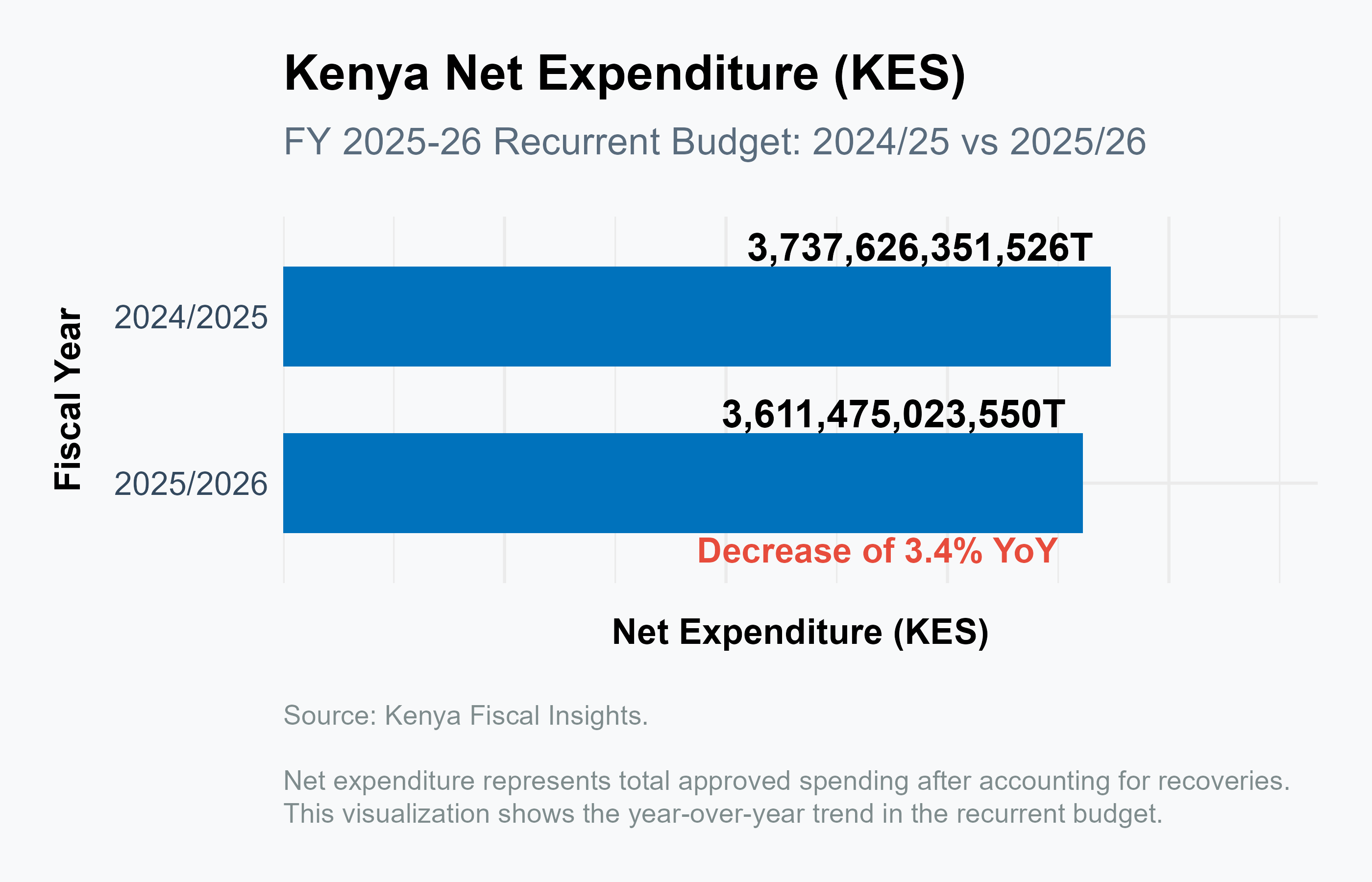
Kenya's recurrent budget continues to reflect the government's ongoing efforts to balance rising fiscal pressures with the need for sustainable public spending. Analyzing the net expenditure for the two latest fiscal years—2024/2025 and 2025/2026—reveals a notable year-over-year shift.
1. Total Net Expenditure
The data shows:
- KES 3,737,626,351,526 in FY 2024/2025
- KES 3,611,475,023,550 in FY 2025/2026
These figures represent the full net expenditure totals after accounting for recoveries, making them the clearest indicator of how much the government intends to spend within the recurrent budget framework.
2. Year-Over-Year Change
Kenya's net expenditure declined between the two fiscal years, resulting in:
📉 A 3.4% decrease year-over-year
This downward shift suggests a tightening of recurrent spending in FY 2025/2026. While the recurrent budget remains substantial, the reduction reflects efforts toward fiscal discipline and controlled expenditure growth, potentially in response to revenue pressures or debt-stabilization strategies.
3. What the Visualization Highlights
The chart compares the two fiscal years side-by-side, emphasizing:
- The magnitude of spending, represented in trillions of shillings.
- A clear label showing each year's total value.
- A bold annotation describing the 3.4% YoY decrease, color-coded to highlight the contraction.
- Contextual notes explaining net expenditure and its role in the broader fiscal framework.
4. Interpretation and Implications
A reduction in net expenditure can signal:
- Strategic cost containment
- Reallocation toward priority sectors
- Budget restructuring due to revenue limitations
- Efforts to manage Kenya's fiscal deficit
While the decrease is relatively modest, it marks a meaningful shift in recurrent spending patterns heading into FY 2025/2026.